Operating plants
On-site training can interfere with production, require shadowing and occupy the most experienced people.
TwinFor Training

We add an intuitive layer to existing training processes, connecting materials, procedures and assessments to the Digital Twin of facilities, plants and machinery. It does not replace what already works: it makes it more accessible, contextual and useful in real operations.
01Browser-based, with no installation required
02Adds to existing systems without replacing them
03Assessments and results contextualized in the Digital Twin
Manuals, slides and courses transfer information. Technical skills, however, must be applied in real places, systems and situations.
On-site training can interfere with production, require shadowing and occupy the most experienced people.
Facilities, construction sites, buildings and vessels may be distant, unavailable or accessible only at specific times.
Training can involve travel, downtime, safety constraints and inconsistent delivery across sites and groups.
A practical example of how content, places and learning activities can come together in one intuitive environment, adding value to the materials and processes the organization already uses.
Watch the video on YouTubeTwinFor Training does not require organizations to redesign their tools, materials or processes from scratch. It integrates gradually with what is already in use and adds the missing operational context, connecting existing information to the digital copy of the place where it will be applied.
Existing documents, manuals, videos, audio, procedures and learning materials become part of the training journey.
The Digital Twin makes environments, systems, machinery and points of interest explorable without physical access.
An intuitive layer places information and activities where they become meaningful, creating guided and interactive journeys.
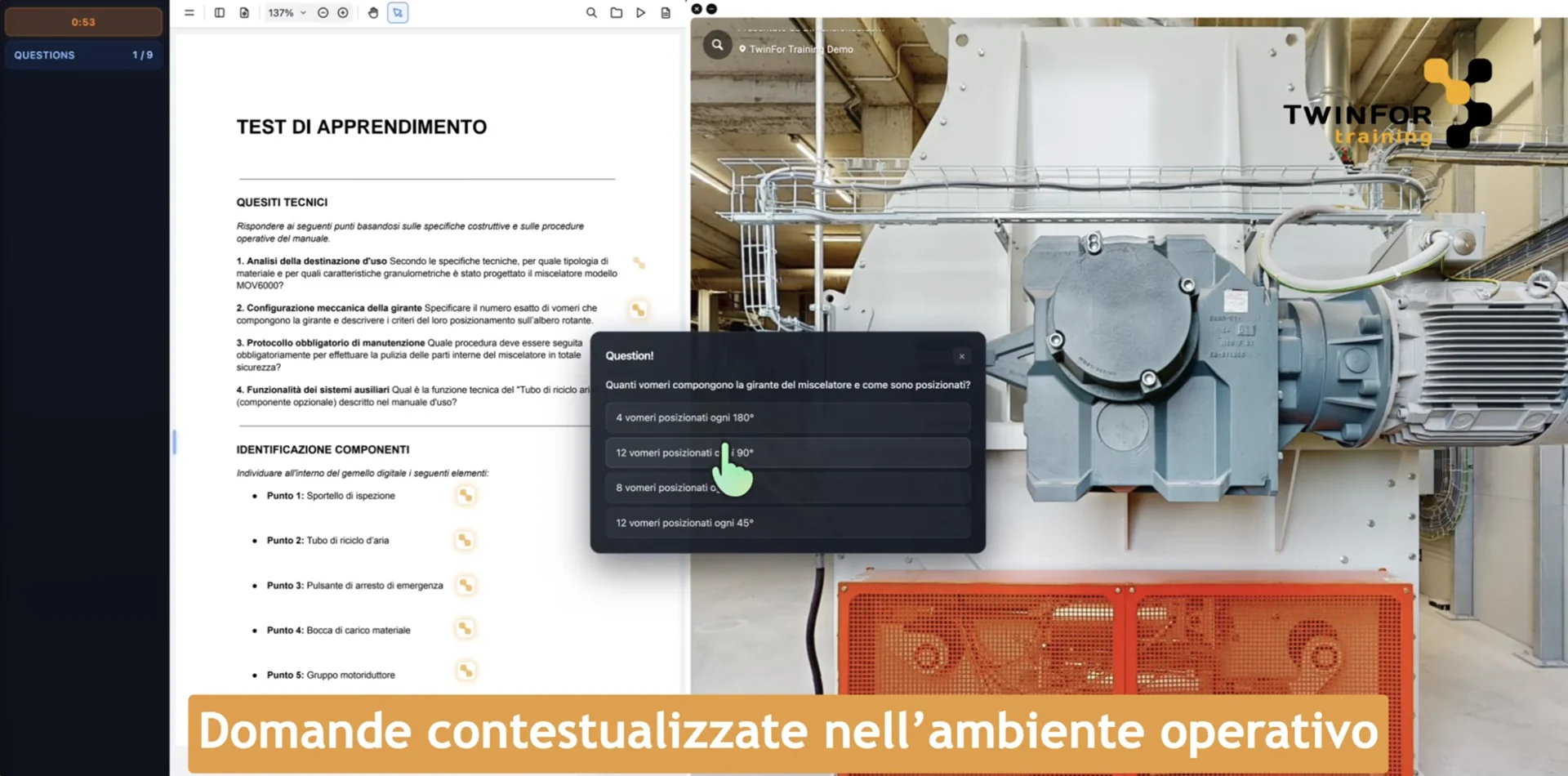
Contextual quizzes and tests measure learning directly in the digital operational environment.
Training sequences organized by role, activity, department, system or skill level.
PDFs, images, video, audio, 3D models and web resources integrated into relevant Digital Twin locations.
Instructions and steps connected directly to the environments, assets and components involved.
Questions and activities can require learners to recognize a real location, system or component.
Answers and outcomes can be recorded to make assessment more objective and repeatable.
Start with one focused use case and progressively add new content, journeys, roles and environments without interrupting current processes.
Learning assessment
A question can ask an operator to identify the correct component, recognize an area or apply a procedure directly in the Digital Twin. Assessment moves closer to how knowledge will be used at work.
Onboarding
Employees and contractors learn spaces, systems, rules and procedures in the Digital Twin before entering the operational environment.
Technical training
Technicians and maintenance teams explore where to act, what information to use and how to navigate assets and systems.
Safety
Dedicated journeys help people understand access, sensitive areas, devices and procedures without exposure to real-world risk.
Knowledge transfer
Experience, guidance and operational knowledge become accessible and updatable content across sites, roles and generations.
Information is not isolated: every item also shows where and how it must be used.
The operational space can be explored remotely, independently and whenever needed.
Adoption can expand by use case, department and site, progressively enhancing existing investments, content and systems.
Assessments and results support more consistent evaluation criteria.
We begin with a concrete learning process, the available materials and a meaningful space. The first goal is not to digitize or replace everything, but to add one useful layer, prove value through a focused POC and grow gradually.
We define users, skills, environment, content and assessment criteria.
We create or integrate the Digital Twin of the space, system or machine.
We build the journey, interactions, content and assessments around the operational context.
We release the POC, gather evidence and define expansion to new roles, sites or processes.
500+
organizations served
2,000+
Digital Twins delivered
20+
countries reached
10+
years of experience
No. The project can start from existing documents, manuals, videos, slides and procedures, which are selected and connected to the Digital Twin.
No. TwinFor Training is browser-based and can be used on computers, tablets and smartphones depending on the project configuration.
Yes. Dimensione3 can assess and integrate existing Digital Twins when they meet the required technical standards. If the space has not been digitized, we can also handle the survey.
Quizzes, contextual questions, component or area recognition, and activities where the answer is given by interacting directly with the Digital Twin.
Yes. Answers and outcomes can be recorded to document learning levels and make assessment more structured and repeatable.
No. It is designed as an additional layer that enhances the LMS, documents, procedures and processes already in place. It can be introduced gradually and, where useful, integrated with the organization’s digital ecosystem.
The survey is planned around the environment and can be organized to minimize impact on operations.
With a POC around a measurable objective: one department, one procedure, an onboarding journey or an assessment that currently requires significant time or physical access.
Tell us how you train operators and technicians today and which materials you already use. Together we will identify a first use case that adds context and value without disrupting existing processes.